Journal entry
Becoming the "AI Person" at Your Company: The Career and Business Case
87% of leaders use AI at work. Only 27% of frontline staff do. Here is what closing that gap is worth, and how to do it without a technical background.
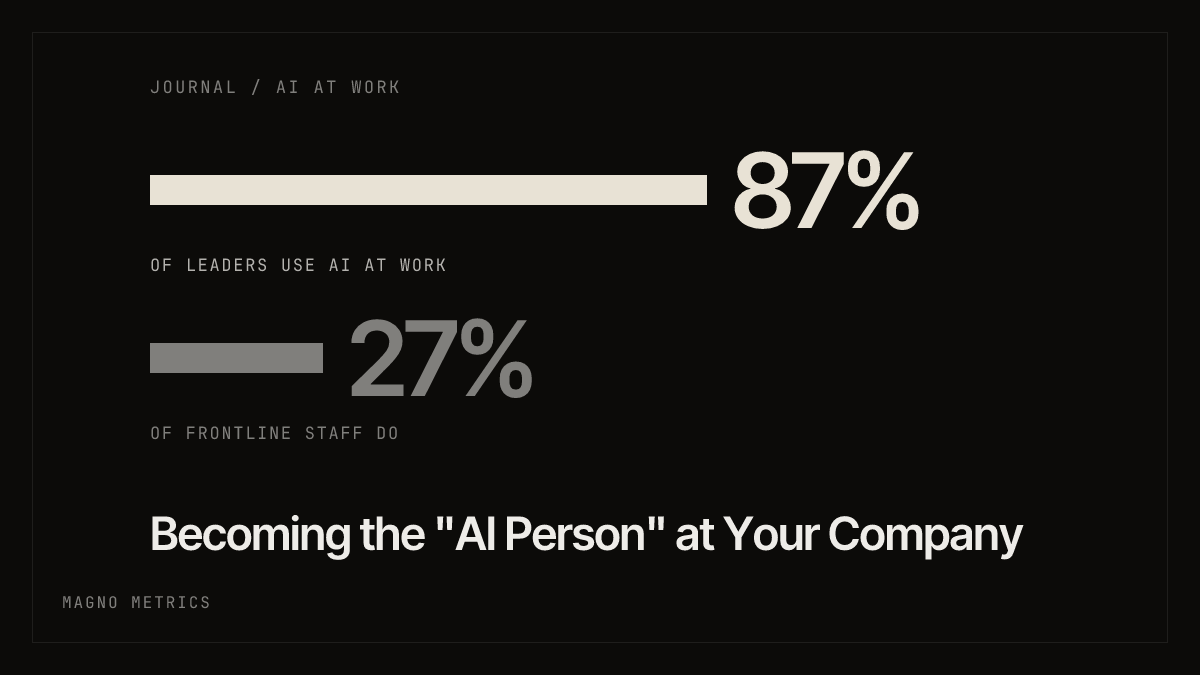
87% of leaders say they use AI at work. Among frontline staff, the number is 27%. Same survey, same companies, same year.
That spread is the whole argument. Most organisations already have an AI strategy written down somewhere. Very few have people who can run it. Leadership has decided this matters. The people doing the daily work were never shown how.
In any company that closes that gap, somebody closes it. That person usually ends up with more say than their title suggests, and sometimes with a client roster that will not let them go.
One definition first, because the term gets used loosely. “The AI person” means whoever others route AI questions to, and who has put at least one working process into daily use. No job title, no machine learning credential. It is the person who can turn “we should probably use AI for this” into something running by next week. See how AI workflow automation gets built for what a finished version looks like.
Key Takeaways
- Roles requiring AI skills carry a 62% average wage premium, up from 57% a year earlier (PwC 2026 Global AI Jobs Barometer, retrieved 2026-07-24). An independent Lightcast analysis puts the same gap closer to 28%. Treat 28% to 62% as the honest range.
- 87% of leaders use AI at work. 27% of frontline staff do. 71% of workers had no AI training in the past year (Dayforce Pulse of Talent, 2025-10-06). The gap is what makes the role worth filling.
- The premium is not confined to engineering. IT leads at 47%, but sales and marketing (43%), finance (42%), operations (41%), legal and compliance (37%) and HR (35%) all sit at 35% or above (AWS survey of 1,340 U.S. employers, via Forbes, 2025-11-19).
- The most AI-exposed companies posted 34% productivity growth from 2018 to 2025, against 24% for the least exposed (PwC). The PwC data is correlational and does not establish which came first.
- Close to 60% of new business owners in 2025 used AI to help establish the business, and half of those adopters said it made starting up cheaper and faster (Gusto, 2025).
Why Companies Still Have an AI Skills Gap in 2026
Companies did not close their AI skills gap in 2026. They talked about it more. Insufficient worker skills are the single biggest barrier organisations report to putting AI into existing workflows, according to Deloitte’s 2026 State of AI in the Enterprise, a survey of 3,235 senior leaders across 24 countries (retrieved 2026-07-24). Just over half, 53%, name “raising overall workforce AI fluency” as a top talent priority for the year.
Read those two findings together and the crux is plain. The skill is the constraint. The organisations that named it as the constraint have not fixed it, and they say so in the same survey. Demand sits at the top, supply is missing below it, and nothing connects the two.
You do not need a mandate from the C-suite to be that connection.
Pick the workflow problem that annoys you most, fix it before anyone assigns it to you, then write it down well enough that it survives being scoped, handed over, and run without you. The scope is the discipline. Most people reach for the org-wide rollout and stall there.
What the AI Adoption Gap Looks Like Inside a Company
The distance between leadership enthusiasm and frontline execution is the clearest evidence that this role is scarce rather than crowded.
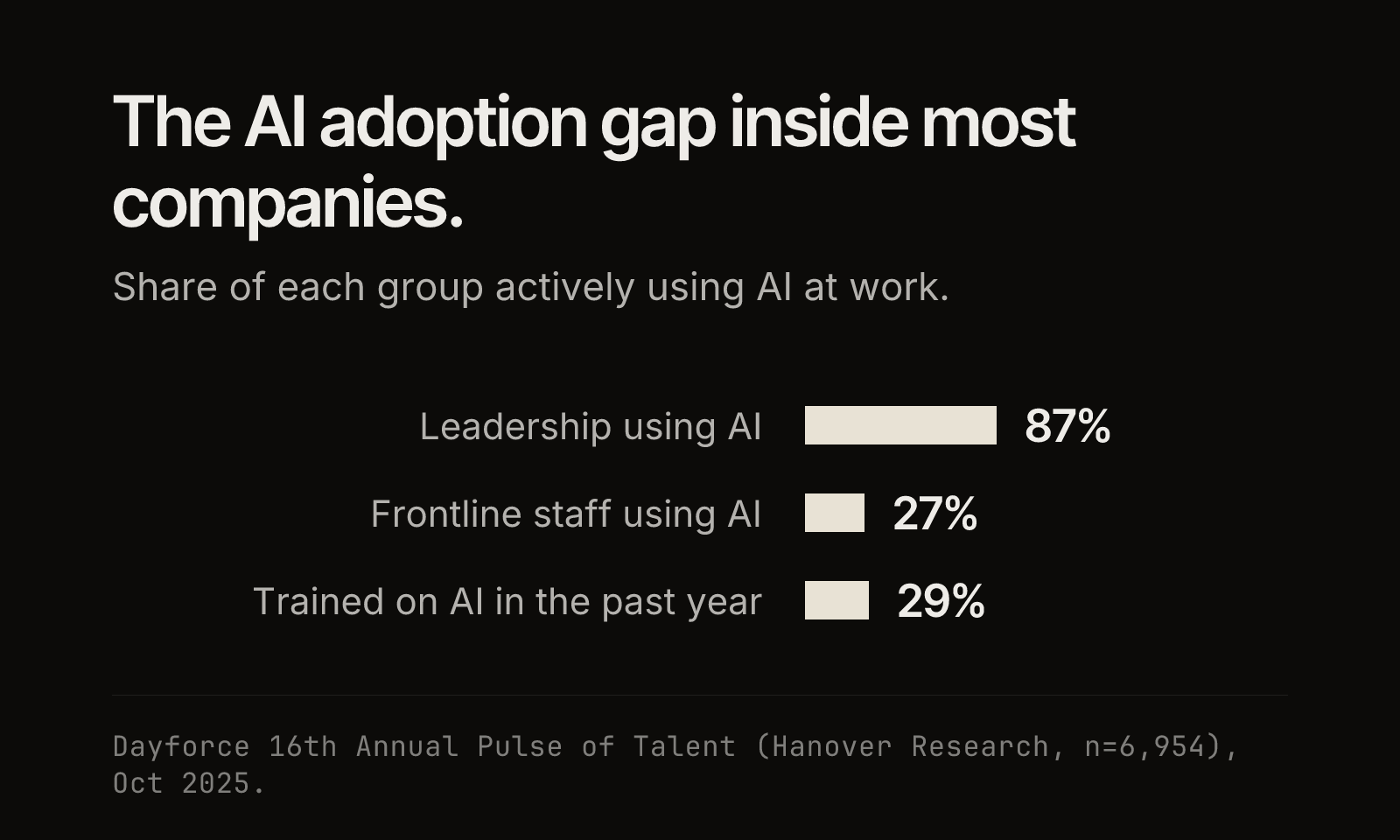
Dayforce’s 16th Annual Pulse of Talent survey put numbers on it. The survey was fielded with Hanover Research across 6,954 respondents in six countries (2025-10-06).
Leaders reporting AI use at work: 87%. Frontline staff: 27%. Over the past twelve months, 71% of workers received no AI training at all, even though 63% say developing AI competency matters for their career.
The executives are aware of this. Eighty-two percent believe organisations should retrain workers whose jobs are affected by AI. Seventeen percent of employees say their employer is doing it.
Four numbers, one conclusion. Leadership wants this, almost nobody below leadership is doing it or being trained for it, and the people responsible for the training say as much themselves. Anyone who closes part of that distance without waiting for a training programme that may never arrive is filling a role their employer has already admitted it needs. A short, scoped AI workflow pilot is usually enough to prove it.
What the AI Pay Premium Is Worth, by Job Function
The wage data does not support the assumption that this only pays for developers. PwC’s 2026 Global AI Jobs Barometer analysed more than one billion job postings across 27 countries (retrieved 2026-07-24). It found a 62% average wage premium for roles requiring AI skills, up from 57% the year before, and the premium showed up in every industry the study covered.
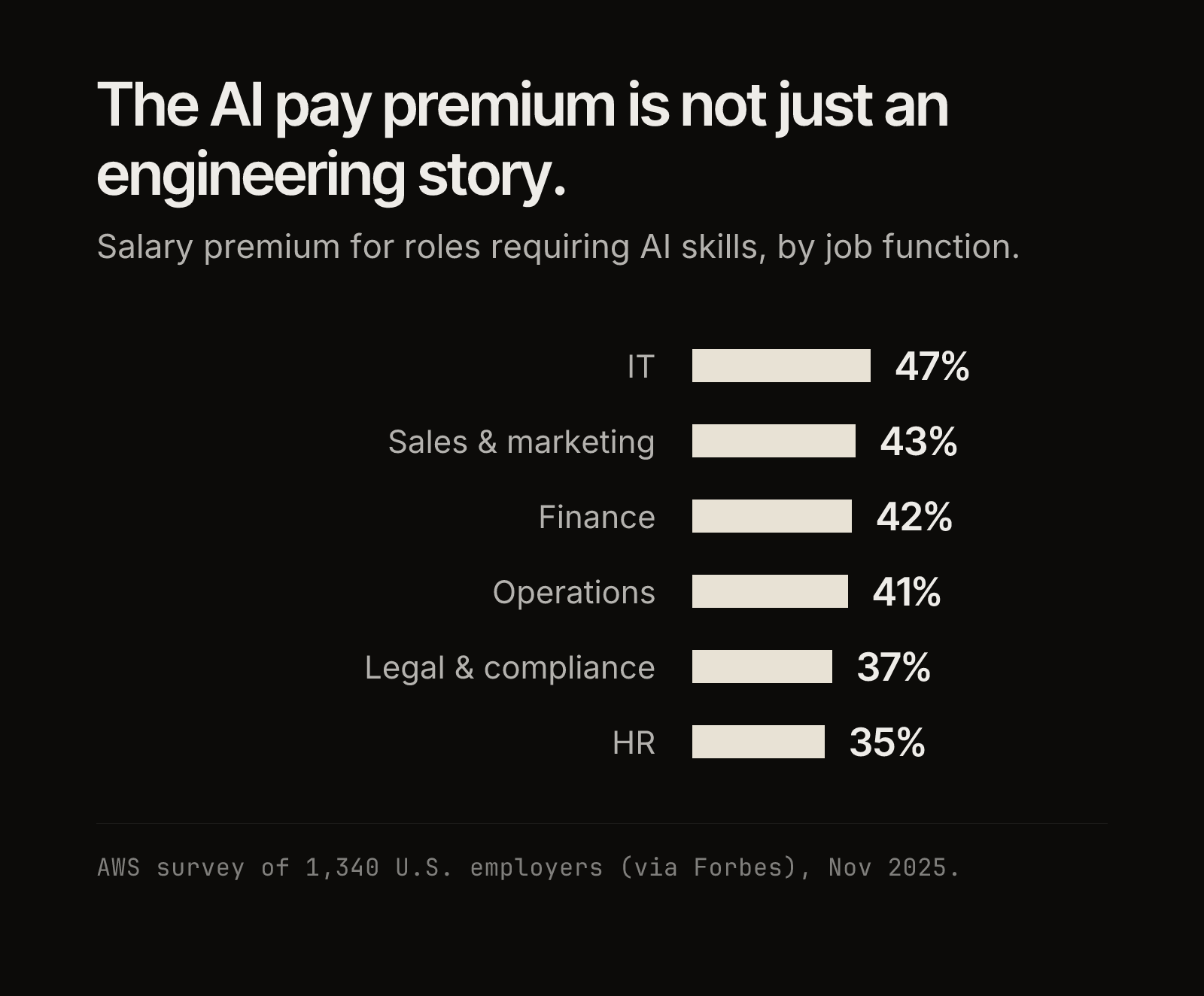
An AWS-commissioned survey of 1,340 U.S. employers, reported by Forbes (2025-11-19), broke the premium out by function. IT roles saw 47% more pay. Sales and marketing saw 43%, finance 42%, operations 41%, legal and compliance 37%, and HR 35%.
A separate Lightcast wage analysis, also reported by Forbes, puts the gap closer to 28%, about an $18,000 salary difference. That is well under PwC’s number, from an independent dataset, pointing the same direction. Take 28% to 62% as the honest range and ignore anyone who quotes one figure as settled.
None of these studies measure the informal role this article is about. “The person everyone routes AI questions to” is not a line on a postings board, so nobody counts it. What the data does show is the mechanism underneath: scarce skill plus high organisational demand produces a premium. That works the same whether the AI work appears in a job posting or in a performance review. Marketing operations is usually where it becomes visible first, because reporting and lead routing tend to be the most manual and most watched processes in the building.
People Are Already Doing Work Outside Their Job Description
Wage data prices the skill but says nothing about who is actually using it. A study OpenAI published on 2026-07-27, Work at the Frontier, measures the behaviour directly, from what people asked for rather than what they told a survey they did.
OpenAI classified more than 800,000 work-related messages from U.S. ChatGPT business users, then compared the task in each message against the sender’s own occupation. The unit of analysis is the request, not the job title. They call the result “task crossover”: work historically associated with one occupation showing up in the AI use of someone in another.
The headline figure depends on which denominator you use. Of work-related messages, 61.5% involve generic tasks belonging to no particular occupation. The other 38.5% are occupation-specific, and within that group, 56.5% sit inside or near the sender’s own occupation while 43.5% sit outside it. Multiply the two and you get 16.8% of all work-related messages. Roughly one work message in six is someone doing another occupation’s job.
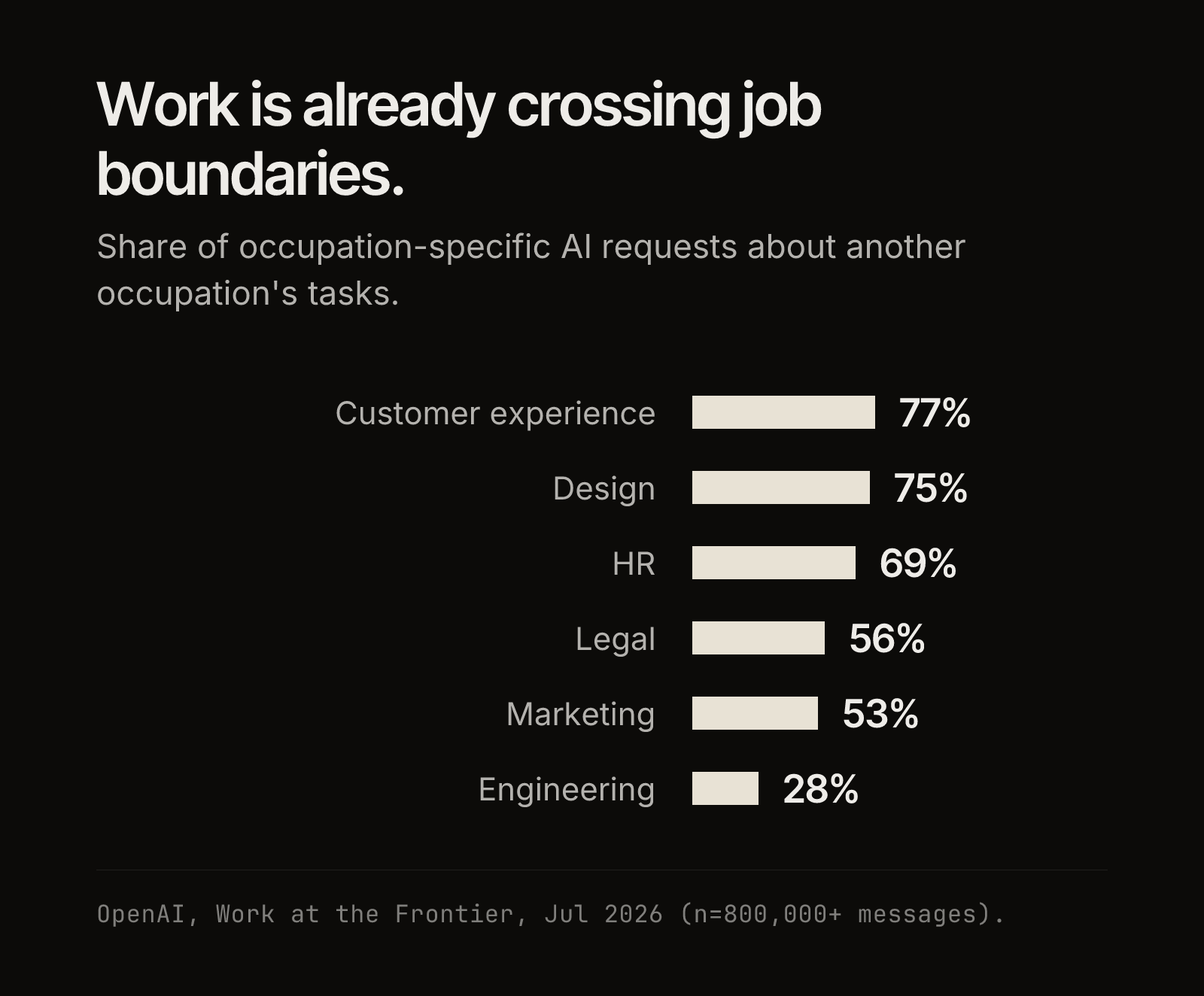
The order matters more than the individual values. Customer experience tops the list at 77%, with design and HR close behind. Engineering comes last at 28%, less than half the rate of the functions above it. That is worth sitting with, because the pay premium data ranked IT first. The two studies measure different things, one what employers pay for and the other what people actually type, and they disagree about where engineering sits.
One honest limit. OpenAI’s researchers state the analysis “does not determine if AI is creating new cross-occupation work versus helping workers perform responsibilities they already had.” It also says nothing about whether the resulting work was any good. Somebody drafting a contract in ChatGPT is not the same as somebody drafting a contract well. Read it as evidence the boundary is moving, not that AI moved it, and not that everything crossing it is competent.
Either way, people are reaching across job boundaries with these tools in volume, mostly without a title change and mostly without anyone assigning it to them. That is the informal version of the role this article is about, showing up in the data before it shows up on an org chart.
What AI Skills Do to Company Growth
The same gap separates companies, and the spread is wider there than it is between individuals. PwC’s Barometer found that jobs requiring AI skills grew 69% year over year, against 9% for the jobs market overall. The most AI-exposed companies posted 34% productivity growth from 2018 to 2025, against 24% for the least exposed. Headcount followed the same shape: 52% growth for the most exposed, 36% for the least.
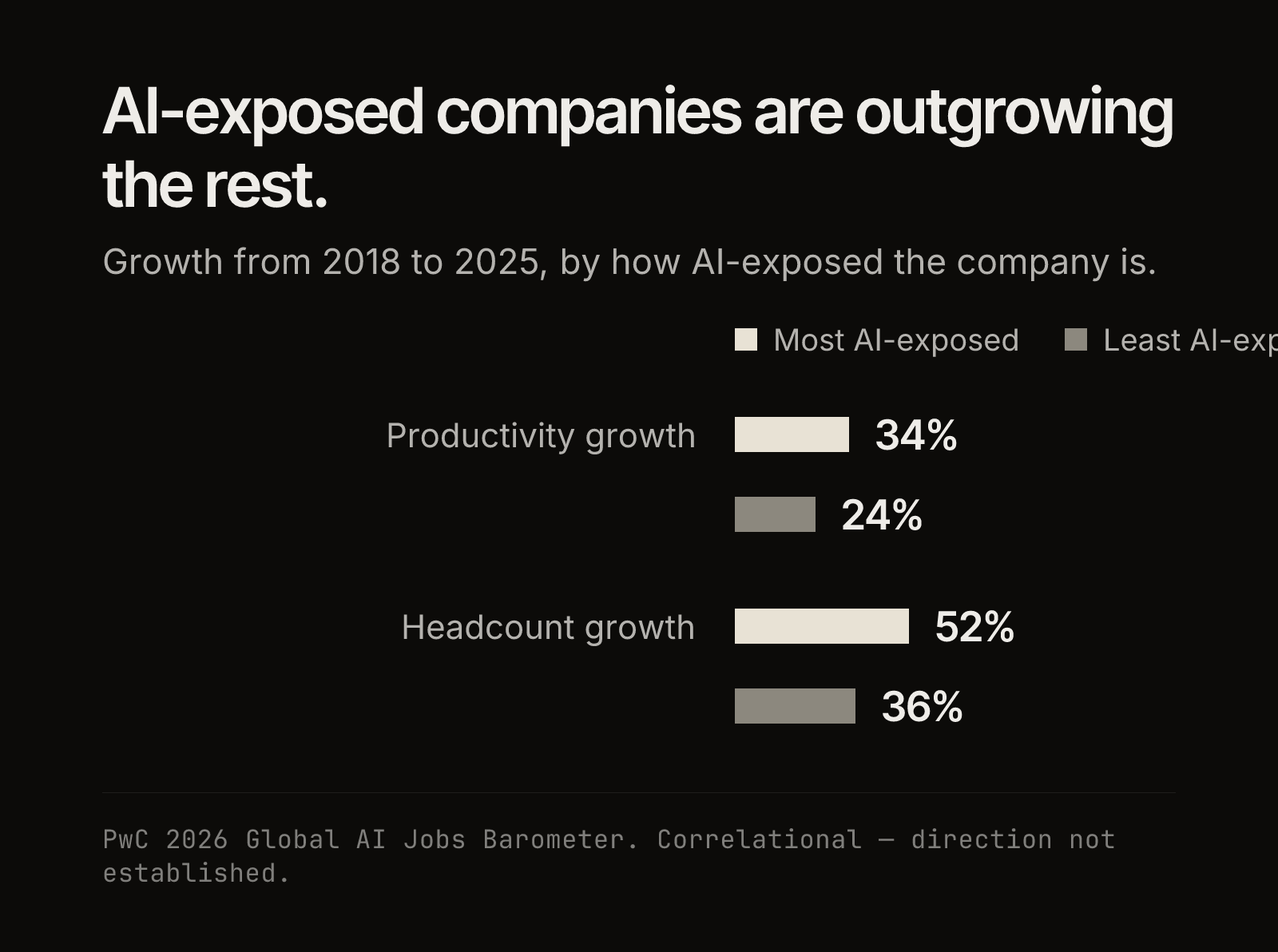
The top 20% of AI-exposed firms, which the report calls “super-star” companies, posted 163% labour productivity growth over that period. Close to five times the average for the AI-exposed group.
One caution on reading this. Exposure and growth are correlated in the PwC data, and the report does not establish direction. Fast-growing companies may just hire more AI-skilled people. The pattern is worth acting on, but it is not proof that AI adoption caused the growth.
For an employee, the practical read is that a company building AI capability is more likely to grow, hire, and fund the projects you want credit for. For a founder, competitors treating AI as a side project are, on average, growing more slowly than the ones who do not.
The Founder Version: Building With AI From Day One
The same pattern shows up earlier for people starting a business than for people climbing inside one. Gusto’s 2025 “New Business Formation” research tracked new business owners. Close to 60% used AI to help establish the business.
The uses were specific. Three quarters used it for business idea development, 53% for administrative or legal work, and 51% for operations setup. Half of the AI-adopting founders said it made starting up cheaper and faster. Adoption ran from 71% among Gen Z founders down to roughly 42% among Baby Boomer founders, and the direction held in every group Gusto measured.
For a solo founder the useful version of this is narrower than “use more AI tools.” Pick the two or three repeating tasks eating the most of your week. Content production, lead follow-up, reporting. Build one working system around them before you hire for that task.
A system documented well enough to hand off is what lets a one-person business produce the output of three. A habit that lives in your head does not do that, and it stops working the week you get busy.
How to Become the AI Person Without a Technical Background
None of the roles above require a computer science degree. They require four unglamorous things, done consistently.
Pick one recurring, annoying task and fix that first. Reporting that eats an afternoon every week. Lead routing that is still manual. A content backlog that never clears. One small, visible win builds the reputation faster than a strategy memo nobody reads.
Write down what you built so it survives without you. A process only one person understands is a bottleneck. A one-page runbook turns a personal skill into something the team can rely on, and something you get credit for.
Say yes to the next adjacent problem. Once one workflow works, the next request is “can you do that for X too.” That is where the nickname turns into how people describe your value.
Measure the after-state. Hours saved per week, turnaround time, error rate. The wage data above tracks demonstrated impact, and the same logic holds inside one company or one client relationship.
On timing, from what we see with clients: a first real win in two to six weeks if you target one narrow workflow. The reputation shift, people routing new problems to you by default, takes two or three cycles of visible wins. Rarely one.
Frequently Asked Questions
Do I need to learn to code to become the AI person at my company?
No. The pay premium and adoption data above cover sales, marketing, operations, HR, finance, and legal. None of those are engineering functions. The work is workflow design, prompt structure, and choosing which task to automate first. Writing software is optional.
What if my company doesn’t have a formal AI strategy yet?
That is the common case. Just over half of organisations, 53%, say raising AI fluency is a top priority, which means most are still writing the strategy rather than running one (Deloitte, 2026). Fixing one real workflow on your own initiative usually builds credibility faster than waiting for a formal mandate.
How is this different from just being “good with computers”?
The adoption and pay data treat AI skill as its own category, separate from general tech comfort. The AWS-reported premiums by function, across IT, sales, finance, operations, legal, and HR, suggest the differentiator is applying AI to a specific business outcome. General software fluency does not carry the same premium.
The Gap Is Still Open
87% and 27%. That spread is the position, and nobody has taken it in most companies.
Organisations have named the skill shortage as their biggest barrier to putting AI into real workflows. Most of their people have never been trained on it. The pay and growth premiums go to whoever closes the distance first, in almost any function. That holds whether you are expanding your scope inside a company or trying to get a business running faster than a founder still doing everything by hand.
The version that works is narrow and boring. One real workflow, written down, with a measurable before and after. Do that twice and the label arrives on its own.
If you want a second set of eyes on which workflow to fix first, book a working session to scope it.
Steve Magnus has spent twenty-five years in digital marketing as an operator and entrepreneur. He founded several startups before starting Magno Metrics in 2019, where he runs the firm’s AI Marketing Consulting practice.