Journal entry
Is AI Getting Cheaper? Yes and No (2026 Data)
Same-level AI gets 13x cheaper a year, but frontier models and full tasks cost more. See what that means for your budget, with 2026 sources.
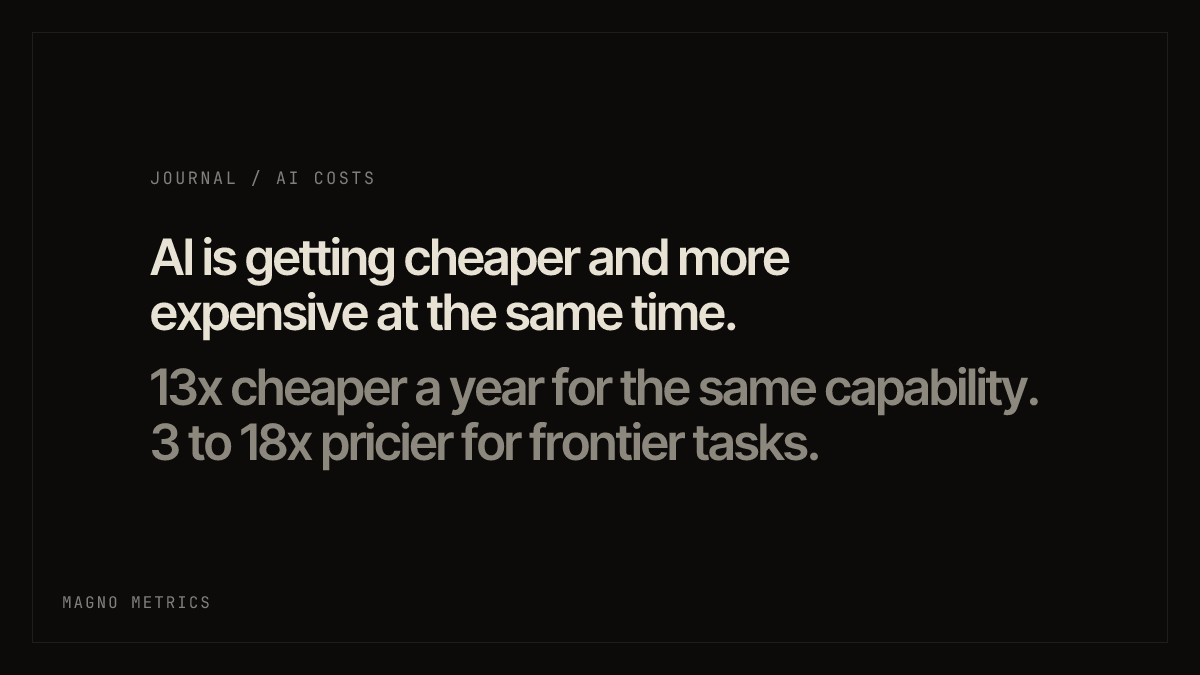
Yes and no. The price of a fixed level of AI capability is falling about 13x a year (Epoch AI, September 2026). The price of the newest, best models, and of a full task done with them, is rising. Which one applies to your business depends on whether you need the best model or a good-enough one.
That distinction decides your AI budget for the next few years. Below: what is falling, what is rising and why, which parts of today’s pricing are temporary, and whether small businesses are being priced out. They mostly aren’t, though not for the reason you might expect.
What Is Getting Cheaper, and What Isn’t
AI price deflation is the fall in what it costs to get a fixed level of AI performance, measured against a set benchmark score. It is real and fast. What it does not describe is the price of the frontier: the newest, most capable models, which have held steady or risen with each generation while older capability got cheaper underneath them.
Both trends are true at once. A business that runs simpler tasks on cheaper, smaller models is riding the falling curve. A business that insists on the newest model for everything is on the rising one, often without noticing, because per-token prices look small and per-task bills arrive later.
TL;DR
- Same capability, falling price. Reaching a fixed benchmark score has gotten about 13x cheaper each year since 2023.
- The frontier is not falling. OpenAI’s flagship output price went from $10 to $50 per million tokens across recent generations.
- Whole tasks cost more at the frontier. Running frontier models on benchmarks costs 3 to 18x more each year, because the models are bigger and reason longer.
- Some prices are temporary, and hardware got pricier. Gemini Flash prices double on January 1, 2027, and memory contract prices rose 90 to 95% in one quarter this year.
- The real small-business divide is know-how, not price. API list prices don’t change with company size, and 70.9% of EU firms that considered AI but didn’t adopt it cite a lack of expertise.
Why the Same AI Gets Cheaper Every Year
The cost of reaching a fixed score on a set of benchmarks has fallen about 47% a quarter since 2023, or roughly 13x a year, according to Epoch AI’s September 2026 analysis. Its worked example: a 75% score on the GPQA Diamond science benchmark cost about $0.30 a question in January 2025 and about $0.0004 less than 18 months later.
The fall is steepest right after a capability first appears, about 75x a year, and slows to about 4.7x a year two years later, by the same Epoch estimate. Epoch flags its own caveats. Models can be tuned to the benchmarks, the data is short and noisy, and the estimate assumes users pick the cheapest model that is good enough.
A separate study, The Price of Progress (Gundlach et al., arXiv), puts the decline for a fixed benchmark score at 5 to 10x a year, and attributes about 3x a year of it to more efficient algorithms. Different method, same conclusion: yesterday’s frontier keeps getting cheaper.
Are AI Costs Increasing? At the Frontier, Yes
Four separate signals point the other way, and they matter more than the headline decline if your business always reaches for the newest model.
1. Flagship prices are rising per generation
OpenAI’s flagship output price per million tokens went from $10 for GPT-5 to $14, then $15, then $30 for GPT-5.5, and now $50 for GPT-6 Astra, according to OpenAI’s API pricing page. OpenAI calls GPT-6 Astra its flagship model for complex reasoning and coding. Better models have not come at the old price.
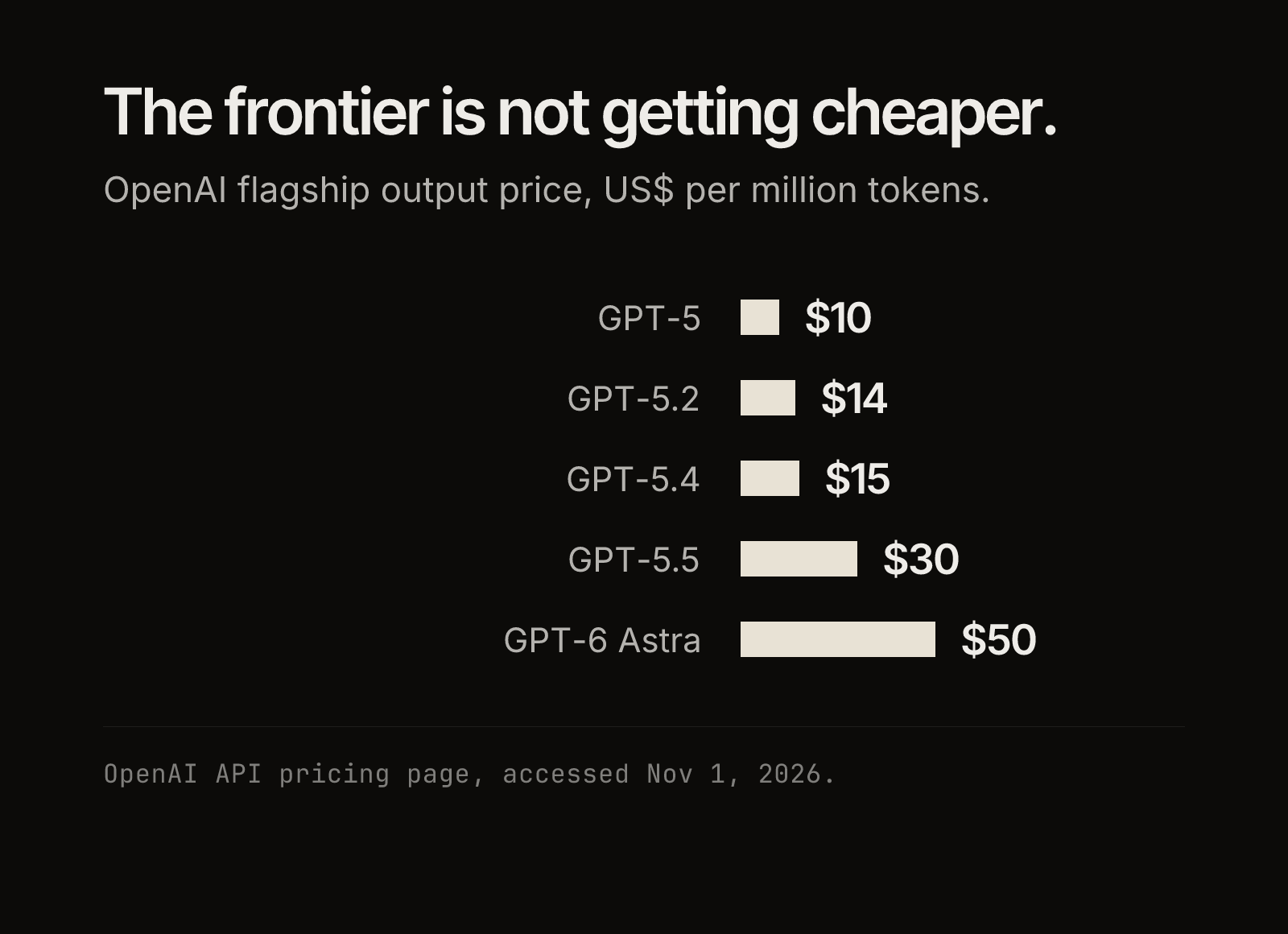
The same price list shows the other trend. GPT-6.1 Sol, which OpenAI describes as “near-Astra performance for complex work at a lower cost,” costs $10 per million output tokens. Near-best gets cheaper while the best gets pricier.
2. A whole task costs more, even when tokens don’t
The same Gundlach et al. study finds that while a fixed score gets cheaper, the cost of running frontier models on those benchmarks is rising 3 to 18x a year. The reasons are bigger models and longer reasoning: today’s models write out more intermediate work before answering, and agents make many calls to finish one job. Per-token prices can fall while the bill for each finished task rises.
3. Some of today’s prices are introductory
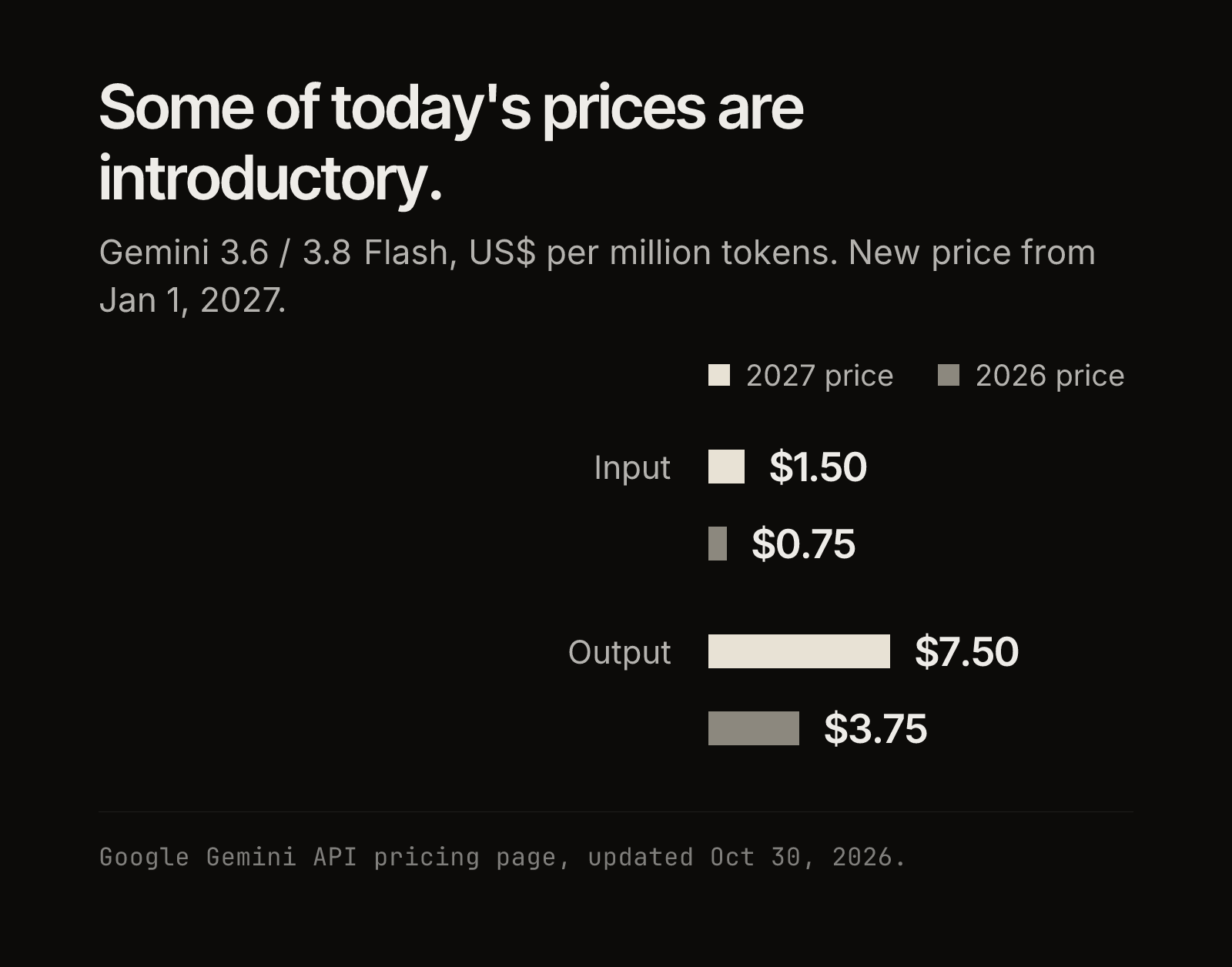
Google’s Gemini API pricing page lists Gemini 3.6 and 3.8 Flash at $0.75 in / $3.75 out per million tokens through December 31, 2026, then $1.50 / $7.50 from January 1, 2027. That is a published doubling. If your costs depend on a promotional rate, budget for the rate after it ends.
4. The hardware underneath got more expensive
TrendForce forecast conventional DRAM contract prices rising 90 to 95% in a single quarter in early 2026, and the realised rise came in at about 93 to 98%. TrendForce attributes the surge to AI and data-centre demand. Nvidia raised its DGX Spark desktop AI system from $3,999 to $4,699, citing “industry wide memory supply constraints” in its price-change announcement.
The Thesis I Started With, and What Held Up
I began this research convinced of three things. AI would never be as cheap as it is right now. Like the wealth gap, a divide would open where businesses with money got the best models and everyone else made do with cheaper ones. And running AI on your own hardware would be no escape, because good hardware costs money.
The evidence split my thesis in half. On the first point, I was wrong as stated: the same capability is falling in price faster than almost anything in technology. I was right about a narrower version, though: the frontier, and a full task done at the frontier, is getting more expensive.
On the second point, I was wrong about access and right about something else, which the section on the AI divide below covers. On the third, I was right that local hardware got pricier, but the cheaper escape turned out to be someone else’s hardware, rented by the token. Being half wrong in public is more useful to you than being confidently right in a LinkedIn post, so here is where each piece landed.
Where Your AI Money Goes in 2026
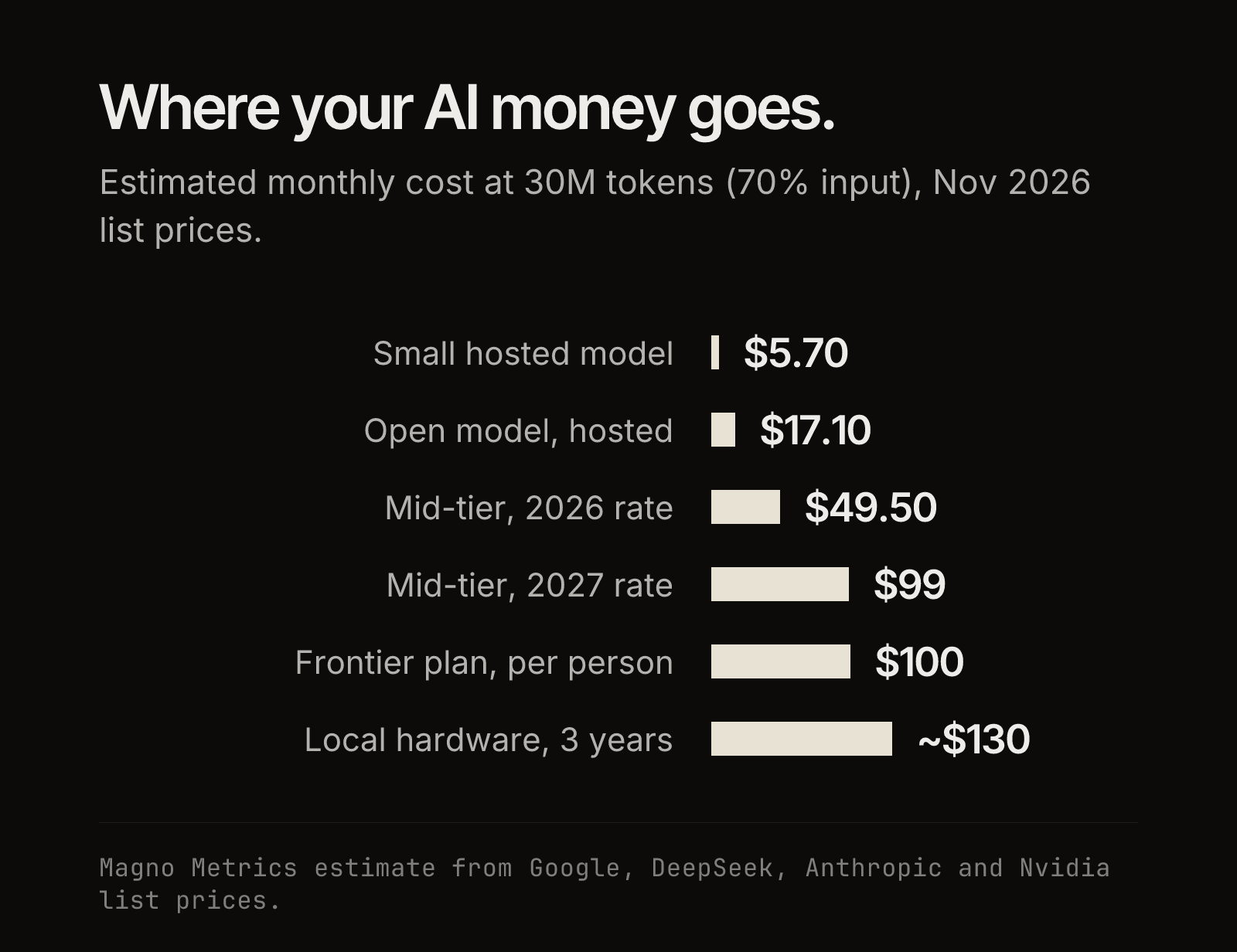
These are list prices as of November 2026. The monthly figures are our estimate for 30 million tokens a month (70% input, 30% output), a realistic volume for a small business running several automations.
| Option | Example price (Nov 2026) | Est. monthly cost at 30M tokens | Price direction | Best for |
|---|---|---|---|---|
| Small hosted model | Gemini 2.5 Flash-Lite: $0.10 in / $0.40 out per 1M (Google) | $5.70 | Falling | High-volume routine work |
| Open-weight model, hosted | DeepSeek V4.1 Flash: $0.30 in / $1.20 out per 1M (DeepSeek) | $17.10 | Falling | Routine work, open-model flexibility |
| Mid-tier on a promotional rate | Gemini 3.6/3.8 Flash: $0.75 / $3.75, then $1.50 / $7.50 from Jan 1, 2027 | $49.50, then $99 | Doubling | Better quality where the step up shows |
| Frontier API | OpenAI GPT-6 Astra: $10 in / $50 out per 1M (OpenAI) | $660 | Rising per generation | Work where the best output changes the result |
| Individual plan | Anthropic’s $100/month plan includes its top public model (Claude plans) | $100 per person | Holding | One person using the frontier daily |
| Local hardware | Nvidia DGX Spark: $4,699 (Nvidia) | About $130 over three years, before power and setup | Rising with memory prices | Privacy, offline use, very high volume |
The pattern is plain. For routine volume, a hosted small or open model costs about $6 to $17 a month. Owning hardware only pays off for privacy, offline work or volumes far above this example.
Will Small Businesses Be Priced Out of AI?
Not on access. A solo founder pays the same list price per token as a Fortune 500 company: Anthropic’s API pricing is the same for every customer, with no size-based discounts listed. What enterprise plans add is governance, such as single sign-on, audit logs, compliance tools and custom data retention (Claude plans). That is paperwork and control, not a smarter model.
The divide that does exist is in use. In the EU, 17% of small firms (10 to 49 staff) use AI, against 55% of large ones (Eurostat, December 2025). Across the OECD the split is 17.4% against 52% (OECD, January 2026). In the U.S., firms with 250 or more staff sit at 37%, while firms with four or fewer sit under 20% (U.S. Census Bureau, May 2026).
The reason is not price. Among EU firms that considered AI and didn’t adopt it, 70.9% cited a lack of expertise, ahead of legal uncertainty (52.5%) and privacy (48.8%) (Eurostat).
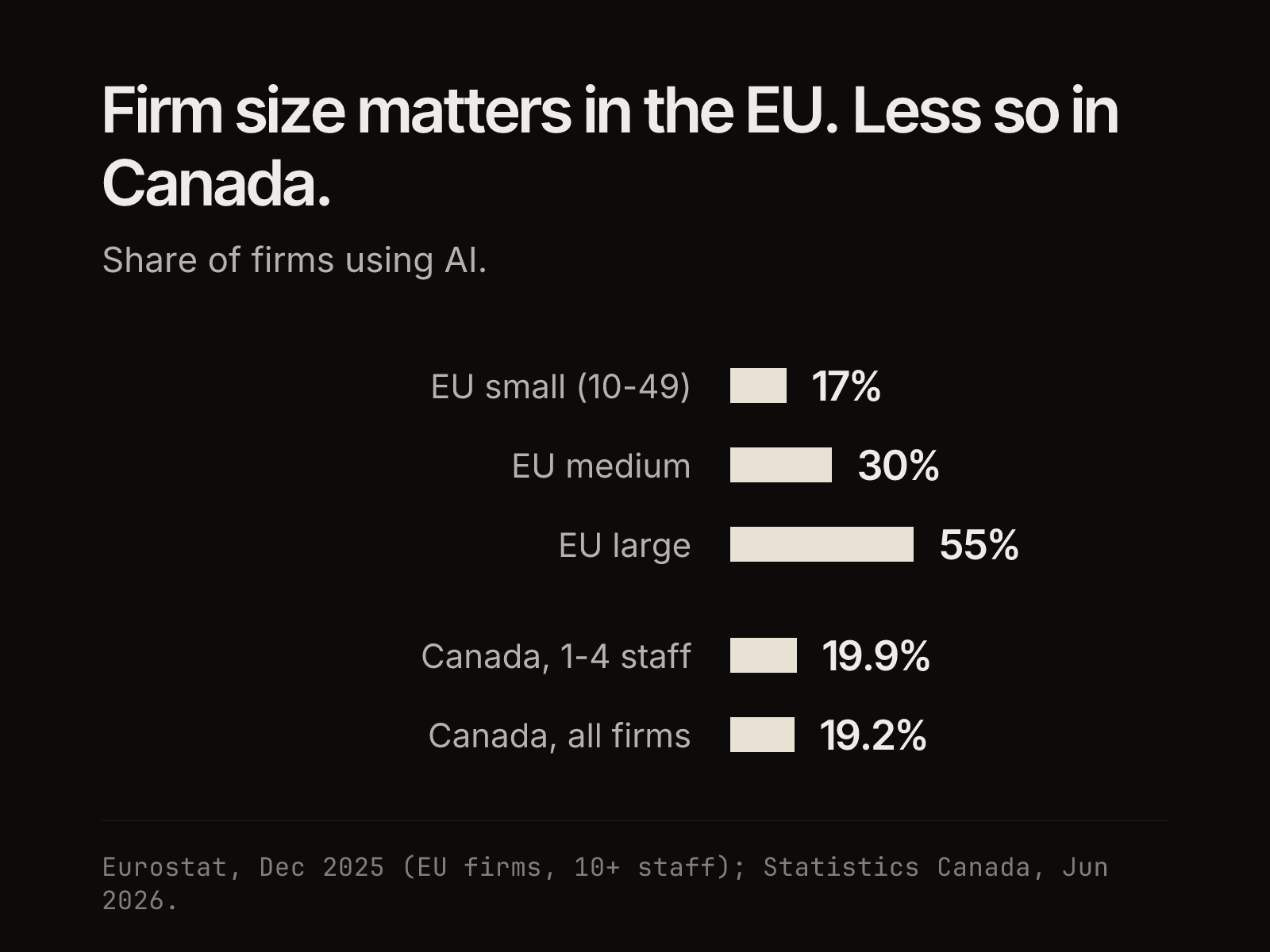
Two findings cut against the gloomy reading. In Canada, firms with one to four employees use AI at 19.9%, at the national rate of 19.2% (Statistics Canada, June 2026). And skill gaps close fast once AI is in use: in a study of 5,179 customer-support agents, AI raised issues resolved per hour by 14% on average and 34% for the least experienced (Brynjolfsson, Li and Raymond, NBER). The divide is know-how, and know-how is the part a small business can build.
For a practical starting point, see our guide to becoming the AI person at your company.
Common Mistakes
- Paying frontier prices for routine work. Summaries, categorising leads and first drafts rarely need the newest model. The price gap between tiers is large and growing.
- Reading per-token price as per-task cost. A cheaper token on a model that reasons for longer can produce a bigger bill per finished job.
- Building a budget on a promotional rate. Check the pricing page for an end date before you build an automation around a price.
- Buying hardware to save money. At small-business volumes, hosted models cost a fraction of a local machine. Buy hardware for privacy or offline needs, not savings.
- Treating access as the barrier. You can buy the same models as an enterprise today. What holds most small firms back is knowing where AI fits.
The Right Way to Budget for AI
Framework: Good Enough First
Step 1: List the jobs, not the tools
Write down the five to ten recurring tasks you want AI to handle. Price the task, not the subscription.
Step 2: Default to the cheaper tier
Run each task on a cheaper, smaller model first. Most simpler tasks are already good enough there, and that price keeps falling.
Step 3: Pay for the frontier only where the output changes
Move a task to a frontier model only when a side-by-side test shows a result your customer or your team would notice.
Step 4: Measure cost per finished task, monthly
Track your bill against tasks completed, not tokens used. That catches the rising per-task cost of reasoning models early.
Step 5: Recheck every quarter
Prices move both ways. Last quarter’s frontier is next quarter’s budget tier, and introductory rates end.
Frequently Asked Questions
Are AI costs increasing?
Yes at the frontier, no for a fixed level of capability. OpenAI’s flagship output price rose from $10 to $50 per million tokens across recent generations, and frontier task costs are rising 3 to 18x a year. Meanwhile, reaching a fixed benchmark score has gotten about 13x cheaper each year since 2023, according to Epoch AI.
Is AI getting cheaper for small businesses?
Yes, for most routine work. A small business processing 30 million tokens a month can pay about $6 with a small hosted model such as Gemini 2.5 Flash-Lite, at November 2026 list prices. Costs rise only when a business uses frontier models for every task or relies on promotional rates that expire.
How much does AI cost a small business per month?
It ranges from a few dollars to several hundred, depending on the model tier. At 30 million tokens a month, a small hosted model costs about $6, a hosted open model about $17, a mid-tier model on Google’s 2027 pricing about $99, and OpenAI’s flagship GPT-6 Astra about $660. An individual frontier plan from Anthropic costs $100 per person per month.
Do I have to pay to use AI?
No, not for basic use. The major assistants offer free plans with usage limits. Paying becomes worthwhile when a business needs higher limits, API access for automation, or the most capable models for work where quality changes the result.
How much does AI equipment cost?
Dedicated local AI hardware starts in the thousands of dollars and rose in 2026. Nvidia’s DGX Spark went from $3,999 to $4,699, citing memory supply constraints, after DRAM contract prices jumped 90 to 95% in a single quarter. For most small businesses, renting hosted models costs far less than owning hardware.
Why is AI getting cheaper so fast?
The cost of reaching any fixed level of AI performance falls fastest right after that level first appears, about 75x a year, and slows to about 4.7x a year two years later, according to Epoch AI. Averaged across benchmarks, it has fallen about 47% a quarter since 2023. More efficient algorithms account for about 3x a year of the decline, according to Gundlach et al.
Action Steps
- Audit your AI spend by task: you will see which jobs are paying frontier prices for routine output.
- Move routine tasks to a cheaper tier: most summaries, sorting and drafts keep their quality at a fraction of the cost.
- Check every pricing page for end dates: you will catch introductory rates, such as Gemini Flash’s January 1, 2027 doubling, before they hit your bill.
- Rent before you buy hardware: run a month on hosted models and buy hardware only if privacy or volume demands it.
- Invest in know-how over tools: expertise, not access, is what separates small firms that use AI well from the rest.
Bottom line: Cheaper, smaller models keep getting cheaper, while the newest AI and the full tasks you run on it are getting pricier. So the winning budget uses cheaper models for simpler tasks and pays frontier prices only where the frontier changes the result.
About the author: Steve Magnus is the founder of Magno Metrics and has spent twenty-five years in digital marketing as an operator and entrepreneur. He runs the firm’s AI Marketing Consulting practice, helping small and mid-sized businesses put AI into daily operations. Connect on LinkedIn.